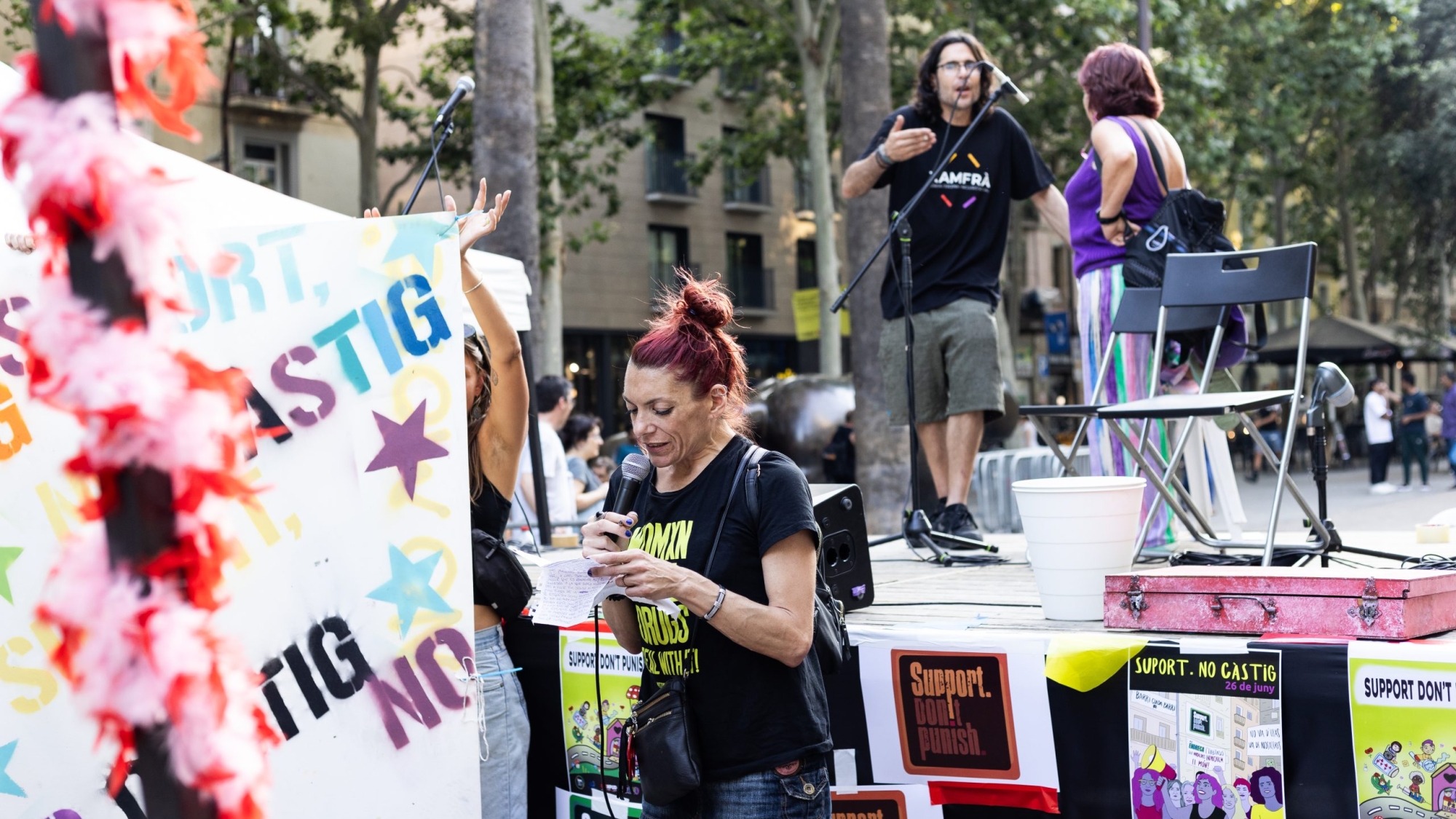
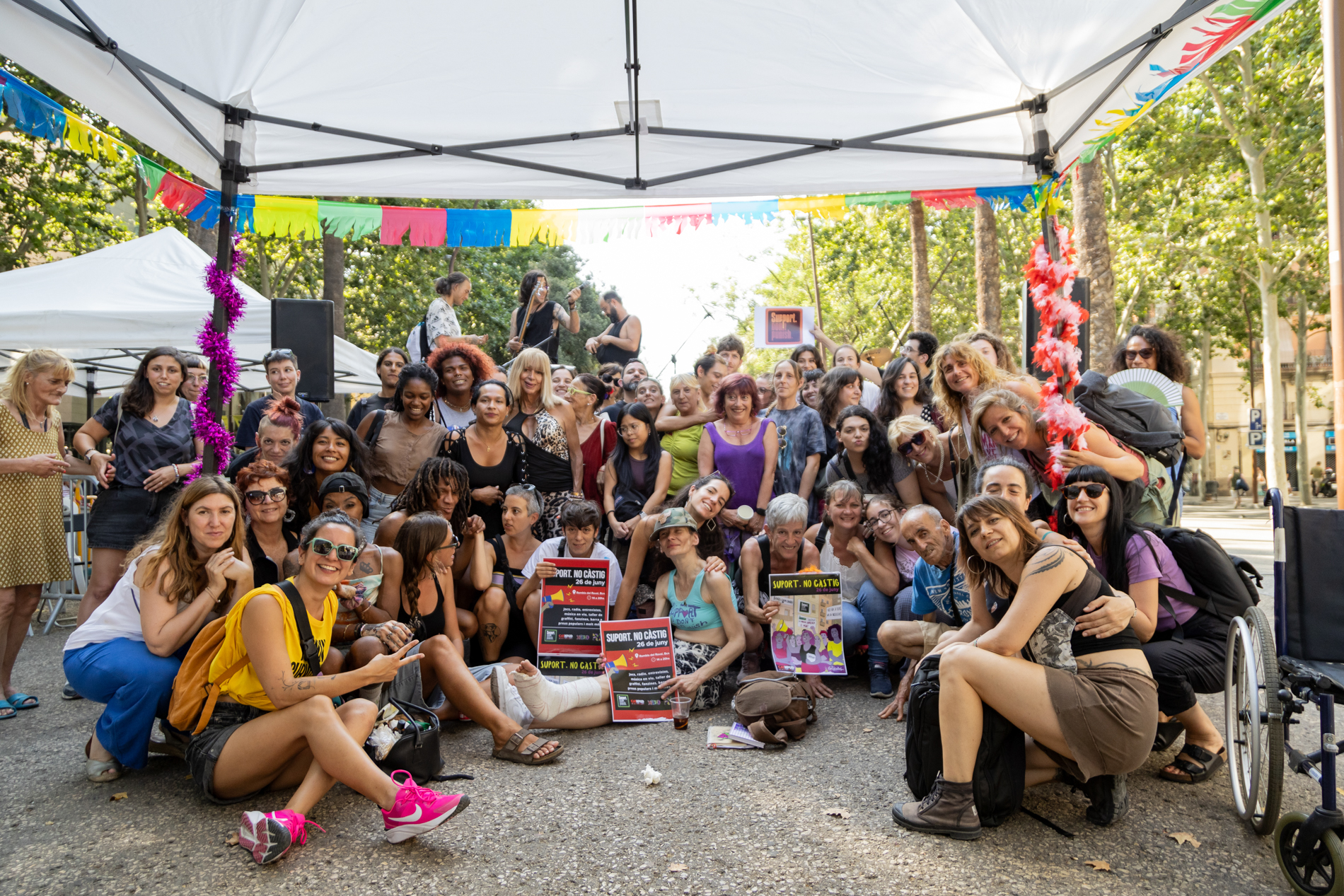
Today, June 26, from the heart of the Raval, we join the global call of Support Don’t Punish. We do not do so from a distance, but from home: because in Catalonia many of us use substances and continue resisting criminalization and systematic punishment. At a moment when we are becoming used to hearing almost daily announcements of the loss of rights, now more than ever it is our turn to be community and to care for one another.
We are living in a context of the global rise of the far right, which trickles directly into our neighborhoods in the form of aporophobia, sexism, racism, classism, and the criminalization of difference. We see social networks normalizing hate speech that was once rejected. Now it is tolerated, applauded, and integrated into our daily lives. It is increasingly easy to point fingers, expel, and condemn. And it is increasingly difficult to live if you do not fit into the productive, patriarchal, consumerist, white, and normative model.
In 2024, more than 600,000 people worldwide died from drug-related causes. In the United States, policies of hatred and repression promoted by Trump are estimated to lead to tens of thousands more deaths. Here, we continue to shout that living and sleeping on the street kills.
These are not conditions we can continue to accept: 84 people died on the streets of Barcelona this year—deaths that cannot be normalized, accepted, or negotiated. They are preventable deaths: they are not accidents, they are the result of political decisions.
We are also feeling this impact here. The Plan Endreça was presented to us as a plan for order, but what it actually organizes is expulsion. More police. More fines. More harassment. More control over our lives.
A few days ago we witnessed the announcement of the closure of cannabis clubs—an example of self-management and harm reduction—which are facing a smear campaign by the City Council, despite being a model recognized around the world. And we already know whose bodies are at the front of the line of those they want to make invisible: undocumented people, sex workers, “mad” people, racialized people, migrants, trans people, survivors of violence, the silenced…
Barcelona was once a pioneer city in harm reduction. But what was born from activism, from the streets, from the struggle of those who could not wait any longer, has been domesticated by logics of control. Today we see how this institutionalization and professionalization empties our struggle of its political strength. And if we do not adapt, they shut us down. We saw this in Reus with the closure of La Illeta: a space that was not simply a social service, but a place where real bonds were woven, where the social and the health sectors joined hands for a common goal. A space created by and with people who use drugs, which today is being dismantled as if this model were no longer valid. The closure of La Illeta is not an exception; it is a warning: when harm reduction is instrumentalized without protecting its political and community roots, it too becomes disposable.
How many more spaces will be shut down until none remain? Harm reduction means accompaniment; it means rights. But as long as punitivism, pathologization, and criminalization remain in place, harm reduction can only be a collective response.