
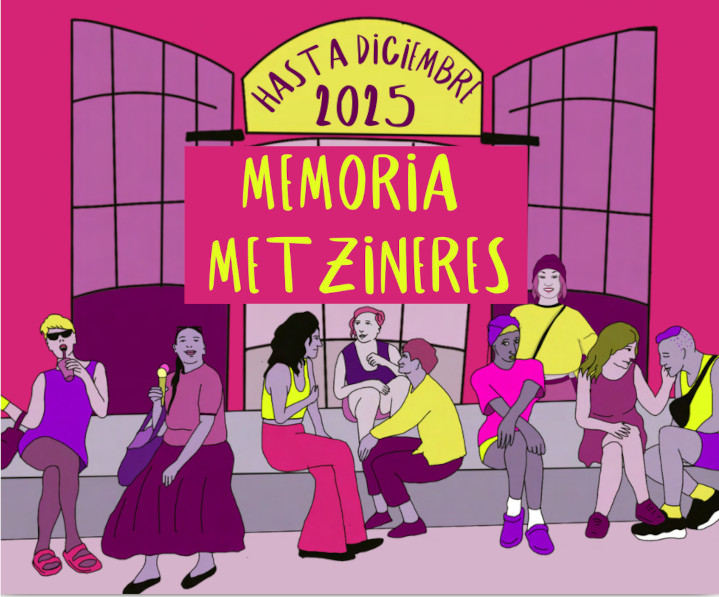
We are publishing Metzineres’ 2025 report: a year in which we carried out 11,181 support interventions with 395 womxn —85 of whom arrived for the first time—, consolidated the Rights Space, and opened L’Arravalera. A community-based practice that shows that harm reduction is also housing, connection, health, and rights.
During 2025, we supported 395 women and gender-expansive people who use drugs and survive multiple situations of violence and vulnerability. Since the project began in 2017, we have supported a total of 748 womxn, 642 of whom remain connected to Metzineres today. These figures speak not only of activity: they speak of people, bonds, and a model that fills a gap no other resource in the area has managed to cover.
We have supported all of them in many different ways: sustaining Espacio Lluna 3 as an everyday home, going out into the streets where they are, defending them legally, providing health and psychological follow-up, facilitating workshops, organizing political advocacy actions, and caring for the neighbourhood in the Raval. We do this from an intersectional feminist, human rights, and full-spectrum harm reduction perspective, and through the Embedding of Peers: the model that places experiential knowledge and technical knowledge on the same level.
“2025 has been a year of high intensity. We have had to adjust opening hours due to financial pressure, but we have not given up what defines us: supporting without expelling, sustaining the bond when life overflows, and making decisions together with the womxn themselves. What the data show is that the model works —and that community is also public policy,” says Aura Roig, founding director of Metzineres.
What we did during 2025
- • 11,181 support interventions with 395 womxn at our premises on Carrer de la Lluna, 3, despite having had to close on weekends and public holidays since May due to lack of funding. 85 womxn arrived at Metzineres for the first time this year. There were days with 68 different womxn inside the premises in a single day.
- • We guaranteed access to basic and violated needs through Espacio Lluna 3: 9,652 accesses to food, 9,572 mutual support interactions, approximately 1,680 showers, 1,680 daytime rests, around 1,400 uses of the washing machine and dryer, 1,127 uses of self-care spaces, and 1,227 accesses to the clothes-swap wardrobe.
- • More than 9,000 consumption support interventions in the dressing room and courtyard; we carried out 55 substance analyses with Energy Control and distributed 6,900 condoms and self-care materials. No overdose occurred inside our spaces, although 16 were recorded outside the premises. This is no coincidence: it is the direct result of connection, trust, and ongoing support.
- • 390 health-related support interventions, including emergency care, primary care, and mental health, 285 of which were with sex workers and women engaged in survival sex. We strengthened follow-up on HIV treatment adherence for 44 womxn and carried out 36 preventive screenings on site.
- • 185 individual psychological support processes and 288 group support interventions, with active presence in crisis situations and episodes of acute psychosis, avoiding coercive interventions and involuntary hospitalizations whenever possible.
- • 1,487 legal actions with 178 womxn through the Rights Space: 641 consultations, 322 coordination actions, 320 support interventions, 26 legal representations in court, 67 prison visits, 33 multidisciplinary reports, and 21 requests for Community Service Orders. Since the beginning, 18 Community Service Order procedures have been carried out and successfully completed within Metzineres itself.
- •The street outreach team carried out 45 outings and 146 support interventions in different areas of Barcelona —Raval, Parc Joan Miró, Poble-sec, Montjuïc, Arc de Triomf—, reaching 35 womxn already connected to the project and 15 new people. They distributed 70 kits for smoked consumption, 85 for injected consumption, 45 naloxone kits, and 150 hygiene and intimate-care materials.
- • We consolidated the community technicians team: 30 womxn connected to the project since the beginning, 6 of whom participate in the Intervention Directorate, 6 provide support inside and outside the premises, 7 are workshop facilitators, and 3 take on representative roles. During 2025, they led 309 support interventions, 72 workshops, and 11 artivism actions. Two represented the project in Lisbon and Porto, and one in Pereira, Colombia.
- • We maintained a stable workshop programme: 48 Guerrilla Sewing sessions with 20 women, 35 Monologueando sessions with 40 women, 29 openings of the Metzitunning hair salon with 50 participants, and 11 feminist self-defence sessions with 10 women.
- • We opened L’Arravalera on Carrer de la Lluna, 20, as a cultural, training, and advocacy space where the MTZ CreActions find a home. It will be consolidated in 2026 with an ongoing programme of exhibitions, gatherings, and training sessions.
- • We strengthened neighbourhood ties in the Raval: we created the Neighbours’ Commission of Carrer de la Lluna, with three meetings already held, and took part in community actions such as Sou Llavor, the Book Fair, Barri cuida Barri, the Carrer Lluna neighbourhood festival, and the Raval(s) Festival.
- • We carried out political advocacy at local and international levels by participating in spaces linked to drug policies, harm reduction, and human rights, such as the Harm Reduction International Conference in Bogotá and United Nations spaces. We continue to be part of the EU Civil Society Forum on Drugs, the Women’s Council of Catalonia, and the Barcelona Municipal Social Welfare Council.
What comes next
In the coming months, we face concrete challenges. The first and most urgent: guaranteeing a stable space where we can continue doing what we do. The second: reopening on weekends and public holidays, because life does not stop during office hours. The third: consolidating L’Arravalera as a stable cultural and advocacy space in the neighbourhood. The fourth: continuing to demand more stable, diversified public funding frameworks aligned with the real timelines of community intervention.
In 2026, we will also premiere the documentary about Metzineres, a piece that tells our story from within: the voices of the womxn, the bonds, the conflicts, the humour, the hardship, and the strength of sustaining life on the margins.
The challenge is no longer to prove that the model works. The challenge is for what works to be able to continue: to have a roof, a budget, and time. For womxn not to have to start over every time the market decides or a grant is delayed.
📄 Download the full 2025 report (PDF)
📄 Defend Metzineres Make a donation, volunteer or join the campaign to protect our space.
If you want to help us sustain this space of rights, care, and community, learn about the different ways you can collaborate with Metzineres here.
