Paella-plen-20maig_web(1)

Almost 4.000 signatures! Now more than ever: we need you on May 28.

An unstoppable milestone

A few weeks ago, we launched the Defend Metzineres campaign with a clear goal: to demand that institutions respond to the threat that real estate speculation poses to our continuity. What has happened since then has surprised us, moved us and, above all, strengthened us.

Almost 4,000 people have signed. The media have reported on our situation. And the property owner has granted an extension until September 30, 2026.

But the extension gives us time, not a solution. And time is running out.

On Thursday, May 28, we need you with us!

On May 28 at 6:00 p.m., Barcelona City Council will hold an extraordinary plenary session to address our situation. This is a real political opportunity. Key issues for the future of community spaces in our city will be decided there. And we need the neighborhood to be present.

The day starts earlier:

🥘 2:00 p.m. – Community paella in front of the premises at midday
✊ 3:30 p.m. – Banner-making workshop at the premises
🏛️ 5:30 p.m. – Mobilization at the Ciutat Vella District Office during the extraordinary plenary session (Plaça del Bonsuccés, 3)

We will be there to demand:

  1. An urgent response to guarantee the continuity of Metzineres in El Raval.
  2. That public administrations take responsibility: rights cannot depend on the market.
  3. The defense of Metzineres, the neighborhood and the networks we weave and sustain together as social organizations.

Metzineres needs you

Metzineres is a non-profit cooperative that, since 2017, has been creating sheltering environments for women and gender-expansive people in situations of vulnerability. What is at stake is much more than a premises.

We are still in time to reverse this situation. That is why we ask you to:

  1. If you have not done so yet, sign and share the campaign on all your networks.
  2. Spread the campaign and the call for May 28. The more people know what is happening, the stronger our pressure will be.
  3. Join us on May 28. Let’s show that the city mobilizes to defend its community spaces!

Rights are not negotiable. Join us in defending our neighborhood!

Sign and share. The struggle continues.


LA IG_ALDARULL. ESPASME COL·LECTI (800 x 600 px)

Open Call | ALDARULL. ESPASME COL·LECTIU

ALDARULL. ESPASME COL·LECTIU is the first collective exhibition by L’Arravalera, a proposal that takes as its starting point the 20 illustrations created by Silustra through conversations with the team and the imaginaries that shape the project: intersectional feminisms, anti-prohibitionism, hacking, art, technology and community.

Through this open call, we invite artists and creators from different disciplines to reinterpret these illustrations and create derivative works. The proposal aims to open a collective conversation about what L’Arravalera is, who we want to be, and what forms of relation we want to build with our immediate context.

The open call is addressed to artists, creators and collectives who feel connected to these questions and practices. We are interested in languages such as craft, drawing, painting, sculpture, graphic arts, digital art, performance, design, photography, video art, cinema, sound experimentation, music and literature, among others.

15 proposals will be selected, and each will be assigned one of Silustra’s illustrations as a starting point to develop a new work.

Key dates
Open call: 15/05 to 07/06
Selected proposals announced: 15/06
Exhibition: 11/07 to 03/10
Venue: L’Arravalera – Carrer de la Lluna, 20, El Raval

To participate, fill in the application form and attach a portfolio, body of work or previous projects as a PDF or link.

Read the full open call guidelines in the PDF HERE.

_B1A9159

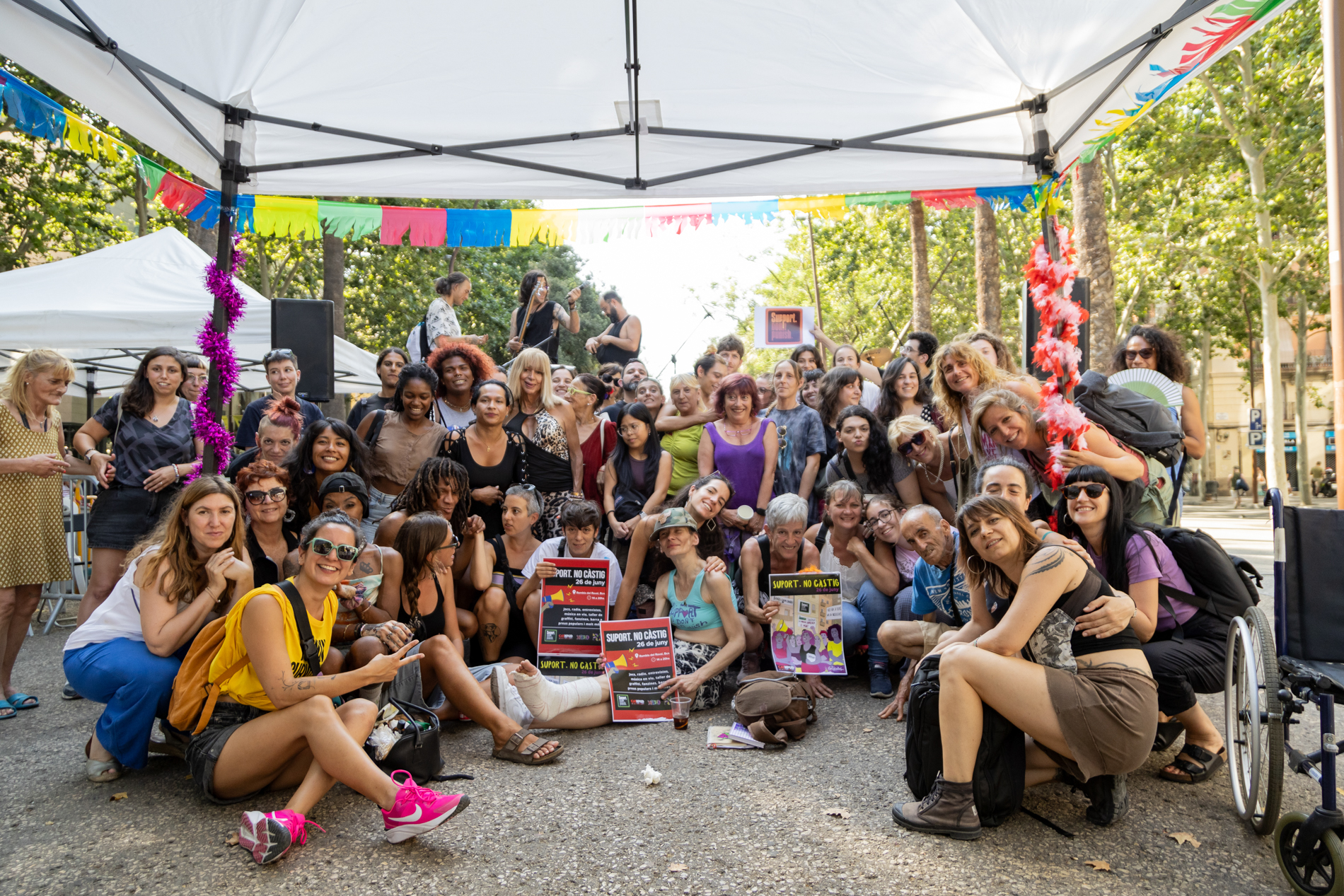
Support. Don’t Punish!

MANIFEST 2025 SUPPORT DON’T PUNISH

We are not “users”: we are people whose rights are being violated. We have a voice. We have a history. We take care of each other when no one else does. We have buried our people. We have accompanied each other through the trip, the high, the I’m not feeling well, the I think I’m getting in over my head, the I don’t know how to do this, the can I stay at your place?, the I don’t know what’s happening to me, the I don’t know who to tell…. We know what is needed. And it is not repression. It is community. It is neighborhood.

But solidarity crosses borders, and we know that the prohibitionist framework goes beyond people who consume: growers, producers, transporters, and sellers of controlled substances suffer disproportionate criminalization.

We do not want to be the friendly face of a system that kills us. We do not want containment: we want the rules of the game to change.

So today we say:

That the use of substances does not justify the denial of our rights. We affirm that we are creators and sustainers of communities from the margins, in the face of the touristified beauty of the city.

That accompanying is not policing. That caring is not sanctioning. That harm reduction is not the administrative management of misery.

That without us, there is no possible drug policy. Nothing about us without us.

That the right to the city also belongs to us: we are here, we stay, and we decide.

This is not about them, it is about us. The neighborhood takes care of the neighborhood.

You can see a summary of Support. Don’t Punish AQUÍ


Amb el suport de:


Dust, Streets, and Knowledge

Self-care and Strategies of Sex Workers Who Use Drugs

Metzineres has launched a project that centers the voices of sex workers who use drugs and survive multiple forms of violence and vulnerability. The project, titled “Survival and Harm Reduction Strategies in Sex Work”,  has been a community-driven, collaborative process to co-create a guidance tool based on lived experience — developed both as a detailed report and as an accessible guide — with the support of researcher Livia Motterle.

It all began in July 2024, with preparatory training sessions, fieldwork, research, diagnostics, interviews, and neighborhood meetings. Gradually, informal conversations, weekly assemblies at the Metzineres space, and even a community paella became spaces of listening and trust. From this process, 20 in-depth interviews emerged.

The result was a 100+ page document of analysis, reflection, and survival and resistance strategies — far exceeding our expectations. It places the experience of sex workers themselves at the center of knowledge production (to be used in actions and/or public policies that, in turn, will help make their rights effective). The first presentation and feedback session for this process took place during this year’s Festes del Raval as a way to begin raising awareness, fostering dialogue, and encouraging advocacy.

Likewise, the draft of the final practical guide was presented at Arravalera — a community, cultural, anti-prohibitionist, and transfeminist space also promoted by Metzineres — which gathers real strategies of survival and harm reduction, defending the rights of sex workers. This is a material co-created with and for them, which continues to strengthen the network of mutual support and community resistance in the Raval.

With the support of the Barcelona City Council – Directorate of Feminisms and LGTBI of the Department of Culture, Education, Sports, and Life Cycles.

Ilustración_sin_título 6

Womxn experiencing homelessness and surviving multiple forms of violence and systemic vulnerability

It is estimated that the number of womxn experiencing homelessness is three and a half times higher than what the data reflects. Womxn are one of the populations at highest risk of being in this situation and, in many cases, face unimaginable (re)traumatization.

Gender-based violence, the fact that women continue to take on the role of caregivers to a greater extent, and other social inequalities mean that homelessness manifests differently for men and women—differences that have not been sufficiently studied. In homelessness counts in Catalonia, women staying in emergency or shelter resources of the Integrated Care and Recovery Network for Women Experiencing Gender-Based Violence are still ignored. According to the data from the Arrels Foundation report from December 2023: 87% of people sleeping on the street are men, 10% are cis women, 1.3% are trans women, and approximately 1.3% identify with other gender identities. Beyond these percentages, we must add all those womxn who do not leave the family home or live in inadequate housing out of fear of ending up on the streets. This comes at a high psychological and physical cost that is difficult to reverse. Moreover, living on the street carries many risks for womxn, as they are more exposed to gender-based violence and sexual abuse.

Among the womxn sleeping on the street, only 31% have income, yet it is not enough to meet their basic needs. 32% do not have anyone they can rely on. Only 33% were born in Barcelona or other municipalities in Catalonia. Job loss, family problems, and migration are the main reasons for losing their housing. Three out of ten suffer from chronic diseases affecting the liver, kidneys, heart, stomach, or lungs. Homelessness takes a heavy toll on the physical and emotional health of womxn, as well as on their overall well-being, especially for those with mental health disorders. We can say that one of the most forgotten groups is that of homeless womxn who are survivors of violence and multiple situations of vulnerability, and who have issues related to drug use.

Metzineres is one of the few existing spaces specifically designed for cis women and gender non-conforming people who use drugs and are surviving multiple forms of vulnerability and violence, including homelessness—whether temporary or long-term.

With holistic and individualized approaches tailored to each person’s specific circumstances, we offer multiple safe spaces through flexible, low-threshold, and immediate-access services, based on the expectations, concerns, curiosities, interests, and needs of the womxn who reach out to us. In this way, we provide comprehensive and individualized support that promotes physical, emotional, and mental well-being.

Our community space serves nearly 600 participants, with an average of 50 visits per day. More than 50% of these participants are unhoused, highlighting the critical need for a space that offers daytime rest with beds, meals, showers, laundry facilities, socio-health support, computers, lockers, a variety of community workshops, training sessions, and a leisure area for peer connection. Meeting basic needs in this way is an essential first step to addressing other layers of vulnerability, needs, and concerns.

We provide transdisciplinary support with holistic and individualized care. This includes self-care tools, professional support in harm reduction, prevention, treatment follow-ups and care, socio-educational support, as well as ongoing legal and psychological assistance. Our work is coordinated with specialized networks, and we refer participants to other complementary services based on each womxn’s specific process. We also conduct weekly outreach to reach and support womxn who, for various reasons—such as carrying bags and belongings—do not come to Metzineres or other local services. Additionally, we carry out community awareness activities with key local stakeholders, neighborhood networks, and the cooperative fabric, fostering feelings of belonging and collaboration that enhance coexistence and nurture us with solidarity and mutual support.

The community outreach work we do allows us to reach this population and provide the necessary holistic and socio-health support to ensure that each womxn receives clear, accessible, and tailored information, as well as coordinated referrals and guidance. This is especially important for those who, for various reasons, do not access the services offered by public administration. It also helps make them visible and raises awareness. Up to August 2024, 245 womxn in situations of homelessness or rough sleeping received transdisciplinary support from Metzineres.

This project is carried out with the support of the Department of Social Rights and Inclusion of the Government of Catalonia.